
How to Cite ChatGPT in MLA 9th Edition
Try it now - paste a URL, DOI, or ISBN
To cite ChatGPT in MLA 9th edition, describe the prompt in quotation marks, add the word prompt, then give ChatGPT in italics, the model name, OpenAI, the date the response was generated, and the share link to the conversation. ChatGPT is never listed as the author. In your text, cite the first words of the prompt description: ("Describe the theme").
"Describe the theme of nature in Jane Austen's Mansfield Park" prompt. ChatGPT, model GPT-4o, OpenAI, 23 Sept. 2024, chatgpt.com/share/66f1b0a0-d704-8000-be9a-85f53c850607.
That entry is the MLA's own example, copied from its updated and revised guidance on citing generative AI, published on 13 August 2025. In the formatted entry, ChatGPT is italic, and so is Mansfield Park, because a book title inside a quoted title keeps its italics. The code block above cannot show italics, so add them when you paste.
If your library guide shows a different version, with "13 Feb. version" and a link to chat.openai.com/chat, it is reprinting the MLA's first guidance from March 2023. Two parts of that format have since changed. The section after next covers both.
The official MLA rule for ChatGPT
MLA 9 has no separate ChatGPT template. The MLA fits AI output into the same core elements it uses for every source, and it skips the ones that do not apply. Its starting position, kept unchanged since 2023: "We do not recommend treating the AI tool as an author." The 2025 post says this follows publisher policies, including those of Cambridge University Press, the partner publisher of the MLA's journal PMLA.

Format:
"Description of what was generated" prompt. ChatGPT, model [model name], OpenAI, Day Month Year, share URL.
| Core element | What goes there for ChatGPT |
|---|---|
| Author | Nothing. Start with the title. |
| Title of source | A description of what ChatGPT generated, usually the prompt, in quotation marks, followed by prompt |
| Title of container | ChatGPT, in italics |
| Version | The model, as specifically as you can: model GPT-4o |
| Publisher | OpenAI |
| Date | The day the response was generated, not the day you wrote your paper |
| Location | The share link to the conversation, or the general URL if no share link exists |
A few details in that table trip people up.
The word prompt sits outside the closing quotation mark, in roman type, and the period comes after it: "Describe the theme of nature in Jane Austen's Mansfield Park" prompt. The quoted part is a description, so the MLA writes it in your words and capitalizes it like a sentence. You are not giving the prompt a formal title.
The date follows MLA 9 order: day, abbreviated month, year. September becomes Sept., as in the MLA's example. The MLA's examples also drop the https:// from the URL.
What changed in August 2025
The MLA says its guidance "has largely remained the same," but it names two significant changes in the 2025 revision. Several of the library guides that rank for this query still print the 2023 entry, so here is what to update.
| Element | March 2023 guidance | August 2025 guidance |
|---|---|---|
| Version | A dated release: 13 Feb. version | The model name or number: model GPT-4o |
| Location | The general URL, chat.openai.com/chat | A stable, shareable link to the conversation; the general URL only when the tool offers no share link |
| Author | No author | No author (unchanged) |
| Title of source | Description of the prompt | Description of the prompt (unchanged) |
The location change came from the tools. When the MLA published its first post on citing generative AI in March 2023, ChatGPT had no built-in way to share a conversation, and the post pointed readers to an outside Chrome extension, ShareGPT, if they wanted a unique link. Now, the 2025 post says, ChatGPT and DALL-E let you share a link from the Share option at the top of the conversation. With a link, your instructor can open the exchange you cited and read it.
The version change follows the same logic. The 2023 examples were made with ChatGPT 3.5, which identified its versions by date, so a date was the most specific version information available. The 2025 examples name the model instead, and the MLA asks you to record the model you used.
The 2023 entries still follow the same template, so an older paper written to that guidance did not break any rule. For anything you write now, use the 2025 form. Penn State University Libraries' MLA quick guide already shows it, with a model name and a chatgpt.com address.
How to write the prompt description
The title-of-source element is the one you write yourself, so it is the one most likely to go wrong. The MLA gives you two options.
A detailed description repeats the prompt closely: "Describe the theme of nature in Jane Austen's Mansfield Park" prompt.
A general description summarizes it: Theme of nature in Austen's Mansfield Park prompt. The MLA says this shorter form can be used "since you are describing something that mimics a conversation, which could have various prompts along the way."
Pick the detailed form when one prompt produced the text you quote. Pick the general form when the material came out of a back-and-forth of several prompts, where quoting any single one would misrepresent the exchange.
Two practical limits:
- If your text already names the prompt ("When I asked ChatGPT to compare the two endings..."), the MLA allows a shorter description in the entry, because the prompt information is already in your prose.
- Very long prompts make unreadable entries. Cut to the part that identifies the content. "Write a 500-word summary of the causes of the 1929 crash, in plain English, for a high school audience, with three headings" can become
"Summarize the causes of the 1929 crash" prompt.
The in-text citation
MLA in-text citations normally give the author and a page number. A ChatGPT entry has neither, so you cite a shortened form of the title element, in quotation marks, with no page number. The MLA's examples shorten the Mansfield Park description to its first few words:
Nature is depicted frequently throughout Mansfield Park, and it "often mirrors the personalities or inner states of the characters" ("Describe the theme").
The shortened title has to start with the same word as the works-cited entry, so a reader scanning the alphabetized list lands on it. If you cite two ChatGPT conversations whose descriptions both begin "Describe the theme," lengthen each shortened title until they differ: ("Describe the theme of nature") and ("Describe the theme of marriage").
Narrative citations work too. You can name the tool in your sentence, but the parenthetical still points to the entry: According to a response generated by ChatGPT, the novel's estates reflect the morals of their owners ("Describe the theme").
Worked examples
1. Paraphrasing a ChatGPT response
In Mansfield Park, physical locations like Mansfield Park and Sotherton reflect the morality and choices of the people who live in them ("Describe the theme").
"Describe the theme of nature in Jane Austen's Mansfield Park" prompt. ChatGPT, model GPT-4o, OpenAI, 23 Sept. 2024, chatgpt.com/share/66f1b0a0-d704-8000-be9a-85f53c850607.
A paraphrase needs the citation as much as a quotation does. The MLA's rule covers any content you "paraphrase, quote, or incorporate into your own work."
2. Quoting a ChatGPT response
Same entry, with the quoted words in quotation marks in your sentence and the same parenthetical. The entry does not change between quoting and paraphrasing.
3. A conversation with several prompts
Use the general description and one entry for the conversation. Each share link covers the whole conversation, so one link is enough:
Theme of nature in Austen's Mansfield Park prompt. ChatGPT, model GPT-4o, OpenAI, 23 Sept. 2024, chatgpt.com/share/66f1b0a0-d704-8000-be9a-85f53c850607.
The MLA writes the general description without quotation marks, the way MLA 9 treats any description standing in for a title. The in-text form follows suit: (Theme of nature). If the conversation ran across two days, use the date of the response you cite.
4. A poem or story you asked ChatGPT to write, with a title
If you gave the creative work a title, put the title in quotation marks and follow it with a description of the work:
"The Oak Tree" free verse poem. ChatGPT, model GPT-4o, OpenAI, 23 Sept. 2024, chatgpt.com/share/66f1c740-7500-8000-a38b-6d6045c811f5.
5. A creative text without a title
Use the first line, or part of it, as the title, then describe the work. The MLA points to sections 5.28 and 5.29 of the MLA Handbook for this:
"The autumn leaves fall softly to the ground . . ." sonnet about autumn. ChatGPT, model GPT-4o, OpenAI, 23 Sept. 2024, chatgpt.com/share/66f1ce9d-0b38-8000-a209-112496d3e0b1.
The spaced ellipsis (. . .) marks where you cut the line.
6. An image generated in ChatGPT or DALL-E
Images get a caption under the figure, following section 1.7 of the MLA Handbook. The caption uses the same elements as a works-cited entry:
Fig. 1. "Create an expressionist-style image of two people standing on a beach looking at the ocean" prompt, DALL-E, version 3, OpenAI, 23 Sept. 2024, chatgpt.com/share/66f1c3a3-3f90-8000-9750-82c57c4a6592.
Commas replace the periods in a caption, as in the MLA's example. The MLA also lets you put the same information in a works-cited entry instead of giving the full citation in the caption.
7. Microsoft Copilot, Gemini, Claude and other chat tools
The template does not change by tool. Swap in the tool's name as the container, the model you used as the version, and the company as the publisher:
"Description of the prompt" prompt. Copilot, model [model name], Microsoft, Day Month Year, [share link or copilot.microsoft.com]. "Description of the prompt" prompt. Gemini, model [model name], Google, Day Month Year, [share link or gemini.google.com]. "Description of the prompt" prompt. Claude, model [model name], Anthropic, Day Month Year, [share link or claude.ai].
Copy the model name from the tool's model picker on the day you generate the response. Model names change often, so a name you remember from last month may already be wrong.
8. No share link available
Some tools, school-managed accounts and temporary chats cannot produce a share link. The MLA's fallback is the general URL:
"Describe the theme of nature in Jane Austen's Mansfield Park" prompt. ChatGPT, model GPT-4o, OpenAI, 23 Sept. 2024, chatgpt.com.
Save a copy or screenshot of the conversation anyway. Your instructor cannot check a general URL, and the copy is the only record of what the tool said.
Special cases
ChatGPT gave you a fact from another source
Cite the original source, not ChatGPT. The MLA is direct about this: AI tools "can also hallucinate, or make up, sources or incorrectly summarize the content," so it recommends "directly consulting and citing the sources that the AI links to instead of the AI response." In its own example, a Copilot answer linked to a Britannica page on formalism, and the MLA's advice was to click through and cite the Britannica page.
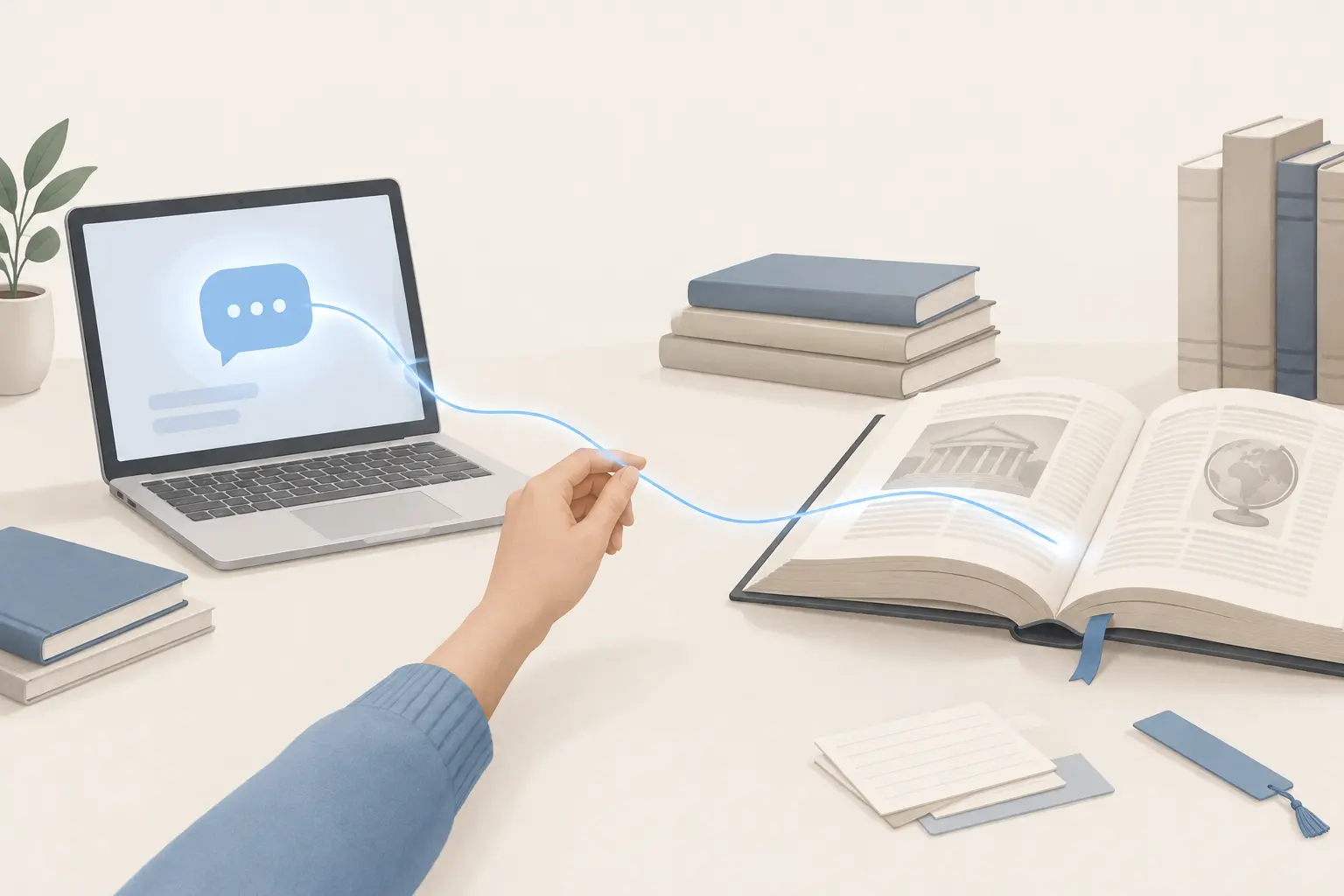
The 2023 guidance described the tool in that situation as "merely a research conduit to the source" and sent readers to section 5.34 of the MLA Handbook. If you cannot reach the original and still want to use the material, the MLA's route is the indirect-source rule in section 6.77, and only when you know the cited source really is where the information came from. ChatGPT sometimes names books and articles that do not exist. If you cannot find the source, do not cite it.
Google AI Overviews and other search summaries
Do not cite them. The MLA's answer on Google's AI Overviews is "No," because the feature is a form of search results, and "search results are not a work." Click through to the page the summary linked and cite that page. The MLA adds that the overview may have pulled an example out of context, so read the source before you rely on it.
You used ChatGPT to edit, translate or brainstorm
You did not quote or paraphrase anything, so there is no works-cited entry to write. The MLA still asks you to "acknowledge all functional uses of the tool (like editing your prose or translating words) in a note, your text, or another suitable location." A note works well for this. The next section has an example.
The share link stopped working
A ChatGPT share link depends on the conversation that produced it. Los Angeles Harbor College's MLA guide to citing AI warns that deleting the conversation from your account also breaks the link. Keep cited conversations until your grade is final. If a link has already broken, MLA has no specific rule for a dead share link; the defensible fix is to give the general URL, as in example 8, and keep your saved copy ready.
Your instructor asks for something different
The MLA describes its template as flexible and invites writers to adapt it when they have a reason. An instructor who wants a full transcript in an appendix, or wants the prompts in a note, is asking for more than MLA requires. Follow the assignment.
Acknowledging AI use beyond citation
In a separate 2025 post, Beyond Citation: Describing AI Use in Your Work, the MLA separates acknowledgment from citation. A citation points to the exact source of a quotation or idea. An acknowledgment tells the reader where the AI's work ends and yours begins, which matters when you used a tool to start research, plan, or draft. The MLA's position is that "generative AI output is not a source in the traditional sense," because it assembles text by "predictive computation" and its provenance cannot always be checked.
The MLA does not prescribe wording. It mentions the educator Anna Mills, who uses notes to record her AI use and prompts and links or appends the chat transcripts. A note in that spirit:
1. I used ChatGPT (model GPT-4o, OpenAI) on 23 Sept. 2024 to suggest an outline for this essay and to check the grammar of my final draft. All analysis and wording are my own except where cited.
MLA endnotes go on a Notes page before the works-cited list. Check your syllabus too. Many courses have their own AI policy, and it can require more disclosure than MLA does.
Common mistakes and how to avoid them
- Listing ChatGPT or OpenAI as the author. This is APA's format, where OpenAI goes in the author position. MLA starts with the prompt description. If you are switching between styles, the APA 7 ChatGPT format is a separate pattern; do not merge the two.
- Copying the 2023 entry. "13 Feb. version" and chat.openai.com/chat come from the March 2023 example. Use the model name and a share link.
- Leaving out the word prompt. Without it, the quoted description reads like the title of a published work.
- Putting the description in italics. The description goes in quotation marks. Only the tool name, the container, is italic.
- Using the date you wrote the paper. The date element is the day the response was generated. Check the conversation history if you are not sure.
- Citing ChatGPT for a fact it took from somewhere else. Find the original and cite that, as the special cases above explain.
- An in-text citation that does not match the entry. The parenthetical must start with the first word of the description, or a reader cannot find the entry in your alphabetized works-cited list.
Quick-reference table
| Case | Works-cited entry (pattern) | In-text |
|---|---|---|
| Quote or paraphrase | "Prompt description" prompt. ChatGPT, model GPT-4o, OpenAI, 23 Sept. 2024, chatgpt.com/share/... | ("Prompt description") |
| Several prompts in one chat | General description prompt. ChatGPT, model, OpenAI, date, share link. | (General description) |
| Titled creative text | "Title" free verse poem. ChatGPT, model, OpenAI, date, share link. | ("Title") |
| Untitled creative text | "First line . . ." sonnet about autumn. ChatGPT, model, OpenAI, date, share link. | ("First line") |
| AI image | Caption: Fig. 1. "Prompt" prompt, DALL-E, version 3, OpenAI, date, link. | Refer to the figure: (see fig. 1) |
| No share link | Same entry, ending chatgpt.com. | ("Prompt description") |
| Fact ChatGPT took from a source | Cite the original source instead | The original's author and page |
| Editing or translation help | No entry; acknowledge in a note | Note number |
For the page layout around these entries (hanging indent, double spacing, the heading), see how to format a works-cited page in MLA 9.
Frequently Asked Questions
Related Guides
How to Cite Wikipedia in MLA 9th Edition
Worked examples for how to cite Wikipedia in MLA 9: the works-cited entry, permanent links, access dates, old revisions, identical titles and the in-text citation.
How to Cite a Podcast in MLA 9th Edition
Worked examples for how to cite a podcast in MLA 9: single and co-hosts, guest hosts, Spotify and app listening, whole series, YouTube video podcasts and time stamps.
How to Cite an Interview in MLA 9th Edition
Worked MLA 9 examples for every interview you will meet: journal, book, YouTube, email, your own recordings, and the anonymous source with no entry at all.
Try AllCitations for Free
No account required. Generate your first citation in seconds.
Start Citing for Free