
How to Cite an Interview in MLA 9th Edition
Try it now - paste a URL, DOI, or ISBN
To cite an interview in MLA 9th edition, put the person who was interviewed in the author slot, then give the interview's title, then the details of wherever it appeared. An interview published in a journal looks like this: Pamuk, Orhan. "Implementing Disform: An Interview with Orhan Pamuk." Interview conducted by Z. Esra Mirze. PMLA, vol. 123, no. 1, Jan. 2008, pp. 176–80. The in-text citation is (Pamuk 179). An interview you ran yourself is shorter: Walcott, Derek. Interview. Conducted by Susan Lang, 22 Oct. 2002.
Those two patterns cover most papers. The rest of this guide covers the cases that are harder to call: an interview with no title, an interview inside a book of interviews, a video on YouTube, an email exchange, a recording only you can hear, and a source who asked not to be named.
The official MLA 9 rule
MLA 9 has no separate interview template. You fill in the same core elements the MLA Handbook (9th ed., 2021) uses for every source: author, title of source, title of container, other contributors, version, number, publisher, publication date, location. The MLA's own post on documenting an interview in MLA style adds three decisions that are specific to interviews.
The interviewee is the author. The person answering the questions goes first, surname first. The interviewer is never the author of an individual interview, even when the interviewer wrote the book it appears in. The MLA states the convention plainly in its answer on naming an interviewee as author, pointing to appendix 2 of the Handbook.
The interviewer is an optional extra. When the interview sits inside another work, you may add the phrase "Interview conducted by" and the interviewer's name after the title, followed by a period. The MLA treats this as a supplemental element: useful, not required.
An untitled interview gets a description. If the interview has no title, write the generic description Interview in the title slot, unformatted, following sections 5.23 and 5.28 of the Handbook. If the interview is not contained in another work, the interviewer's name can follow as a contributor, after the word "Conducted by" and before a comma.
Put together, there are two bare patterns:
Interviewee Surname, First Name. "Title of Interview." Interview conducted by First Last. Title of Container, publication details, pages or URL.
Interviewee Surname, First Name. Interview. Conducted by First Last, Day Mon. Year.
The first is for anything published. The second is for an interview you or someone else conducted that was never published.
In-text, you cite the interviewee's surname plus a page number when there is one: (Pamuk 179). For an unpublished interview there is no page, so the surname alone does the work: (Walcott). If you name the interviewee in your sentence, you can drop the parenthetical or keep only the page.
Published interviews
A published interview takes its title formatting from what kind of work it is. An interview that forms part of something larger (a journal, a book, a newspaper) goes in quotation marks, and the larger work is italicized as the container. An interview that stands on its own, such as a video with its own title, is italicized itself.
1. An interview in a scholarly journal
This is the MLA's own example from its post on citing an interviewee you have named in your prose:
Pamuk, Orhan. "Implementing Disform: An Interview with Orhan Pamuk." Interview conducted by Z. Esra Mirze. PMLA, vol. 123, no. 1, Jan. 2008, pp. 176–80.
PMLA is italicized as the container. The page range covers the whole interview; the in-text citation points to the page you quoted.
Parenthetical: (Pamuk 179). Narrative: Orhan Pamuk has said that the war in Iraq "made life for democrats in this part of the world harder" (179).
If your sentence names the interviewer too, the MLA suggests repeating the surname in the parenthetical so the reader knows which entry to look under: In an interview with Z. Esra Mirze, Orhan Pamuk said that the war in Iraq "made life for democrats in this part of the world harder" (Pamuk 179).
2. An interview in an edited collection
When an interview is a chapter in a book someone else edited, the interview title goes in quotation marks, the book is the container, and the editor goes in after "edited by." This example also uses the optional interviewer element:
Saro-Wiwa, Ken. "English Is the Hero." Interview conducted by Diri I. Teilanyo. No Condition Is Permanent: Nigerian Writing and the Struggle for Democracy, edited by Holger Ehling and Claus-Peter Holste-von Mutius, Rodopi, 2001, pp. 13–19.
The book title is italicized in your paper; the code block above strips formatting so you can copy the punctuation cleanly. In-text: (Saro-Wiwa 15).
3. An interview in a collection where the interviewer is someone other than the editor
Citing the same interviewee in two different collections, the MLA shows the case where the person asking the questions did not edit the book:
Stoppard, Tom. "Dialogue with Tom Stoppard." Interview conducted by Joseph McCulloch. Tom Stoppard in Conversation, edited by Paul Delaney, U of Michigan P, 1994, pp. 38–45.
Here the interviewer element earns its place, because without it the reader would assume Delaney asked the questions.
4. An interview in a book written by the interviewer
When the interviewer and the book's author are the same person, the "Interview conducted by" element would only repeat a name the reader is about to see. Leave it out, and give the author after the word "by" in the contributor slot:
Bechdel, Alison. "Alison Bechdel (2006 and 2012)." Outside the Box: Interviews with Contemporary Cartoonists, by Hillary L. Chute, U of Chicago P, 2014, pp. 155–76.
The MLA flags this as an exception. For a chapter in a book by one author you would normally cite the whole book. Interviews are cited chapter by chapter because the interviewee is the author of each one. The exception has its own exception: if your paper is about the interviewer's work and you cite several of the interviews, you can create one entry for the book and key your in-text citations to it.
5. A newspaper interview with two interviewees
One interview is one work, however many people are talking. Two interviewees go into a single entry, joined the way you would join two authors. Here is the MLA's example on two interviewees in the same interview:
Washington, Denzel, and Michael B. Jordan. "Passing the Torch: Denzel Washington and Michael B. Jordan." Interview conducted by Philip Galanes. The New York Times, 19 Apr. 2018, www.nytimes.com/2018/04/19/arts/television/denzel-washington-michael-b-jordan-black-panther-iceman-cometh.html.
In-text: (Washington and Jordan). Online newspaper articles have no page numbers, so the surnames stand alone.
6. An interview in an online magazine
Online interviews follow the web-page pattern: interview title in quotation marks, the site or publication italicized, date, URL. The Marist College library gives this MLA example, using the "Interviewed by" wording some guides prefer:
Rooney, Sally. "The Beautiful World of Sally Rooney." Interviewed by Olivia Marks, British Vogue, 9 Aug. 2021, https://www.vogue.co.uk/arts-and-lifestyle/article/sally-rooney-interview.
The MLA's current wording is "Interview conducted by" followed by a period, as in examples 1 to 3. Either phrasing identifies the interviewer; pick one and use it for every interview in your list.
7. A video interview on YouTube
A video with its own title is a stand-alone work, so the title is italicized. YouTube is the container, the account that uploaded it is a contributor, and the upload date and URL follow. The MLA's answer on an interview found on YouTube:
West, Kanye. Jimmy Kimmel's Full Interview with Kanye West. YouTube, uploaded by Jimmy Kimmel Live, 10 Aug. 2018, www.youtube.com/watch?v=PmZjaYdS3fA.
Two details in that entry are easy to miss. The interviewer is not added because the title already names him. And the uploader is copied exactly as the account shows it, Jimmy Kimmel Live, which differs from the show's own name, Jimmy Kimmel Live!
For a recording, cite the timestamp in place of a page: hours, minutes and seconds, as the player shows them. A range runs like 00:04:10–35. Our guide to citing a movie in MLA 9 covers timestamp formatting in more depth.
8. A published interview with no title
Here the guides do not agree, and the MLA has not published a contained, untitled example. Purdue OWL's MLA guide to other common sources uses a description built around the interviewer:
Gaitskill, Mary. Interview with Charles Bock. Mississippi Review, vol. 27, no. 3, 1999, pp. 129-50.
For untitled interviews, the MLA's rule is to write the description Interview in the title slot. Applying that literally, an untitled journal interview starts Gaitskill, Mary. Interview. and continues with the container. Both versions give the reader everything they need to find the source. If your instructor uses Purdue OWL, follow Purdue; otherwise the MLA's description is the safer default.
Interviews you conducted yourself
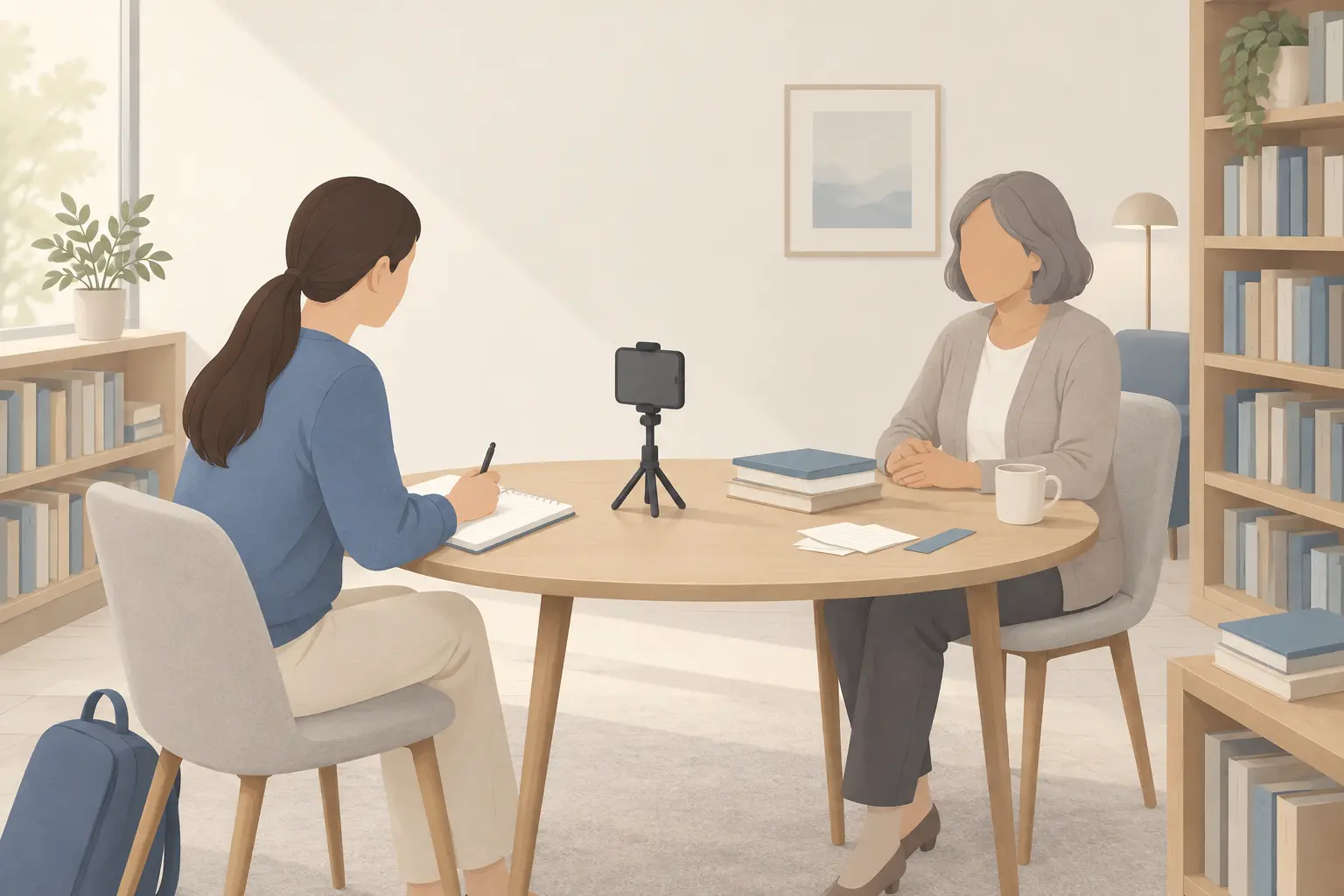
An interview you ran for your own paper has no title, no container and no publisher. What is left is the interviewee, a description, the interviewer and the date. Library guides at Seneca, Otis College and Orange Coast College all file this under personal communications, and all three make the same point: if the interview was published somewhere, cite it as published, because that is where a reader could find it.
9. An in-person interview
Current MLA pattern:
Walcott, Derek. Interview. Conducted by Susan Lang, 22 Oct. 2002.
The interviewer is a contributor in this entry, so a comma follows the name and the date comes straight after. In-text: (Walcott). Most of the time you will name the person in your sentence, and then you need no parenthetical at all.
When you are the interviewer, you can put your own name in that slot. The MLA's example for a recording you made, from its answer on citing an interview that you recorded, uses the interviewer's name the same way:
Clarke, Allison. Interview. Conducted by Joseph Lee, 5 August 2021.
That example spells out the month. The MLA's other interview examples abbreviate it (22 Oct. 2002, 11 Jan. 2018), so 5 Aug. 2021 matches the rest of your list.
10. An interview held over email
Treat the interviewee as the author and put a description that names the format in the title slot. From the MLA's email interview answer, written for the eighth edition:
Smith, Helen. E-mail interview. Conducted by Rachel Green, 6 June 2017.
Some MLA 9 library guides use a different shape, citing the message itself. The Otis College MLA 9 guide to personal communications gives White, Tony. Email to the author. 26 Sept. 2024. and notes that "Email interview" is not required. Both are defensible. Use the interview form when the exchange was a planned set of questions and answers, and the email form when you are quoting one message.
11. An interview over a messaging app or by phone
The MLA extends the email rule to messaging apps: describe the format in the title slot.
Redman, Karen. Facebook Messenger interview. Conducted by Sally Hayes, 11 Jan. 2018.
You do not need to say that an interview was oral, unless the format matters to your reader, in which case "Oral interview" goes in the same slot. The same goes for a phone call ("Telephone interview") or a video call.
12. An interview that ran over more than one day
Treat the dates as a range when they are consecutive and as a series when they are not. Examples from the MLA's answer on a personal interview on two days:
Cohen, Allan. Interview. Conducted by Christine Stevens, 24-25 May 2016.
Doe, John. Interview. Conducted by Jorge Menocal, 2, 3, and 7 Sept. 2016.
13. A recording you made but never published
If you recorded the interview and the file is only on your phone, cite the interview and leave the recording out. You do not add the audio file, the app, or timestamps, because nobody else can play it. The MLA offers two options. Create an entry as in example 9, or skip the entry and add a global note that tells the reader where every quotation came from:
All quotations from Jennifer Stein are from an interview I conducted on 10 October 2022.
If the recording is online, cite it like any online audio or video, and use timestamps in-text.
Special cases

The interviewee wants to stay anonymous
Do not create a works-cited entry. The MLA's answer on citing an anonymous interviewee says to use an endnote instead, stating that the source is a personal interview and giving relevant details such as the method of communication (phone, email, text message, in-person meeting) and the date. That answer was written for the eighth edition, and the Seneca Libraries MLA 9 guide repeats it unchanged.
Quoting a back-and-forth exchange
To quote dialogue between interviewer and interviewee, the MLA sets each speaker's surname in capitals, followed by a period, then the words. The citation goes at the end of the block:
MIRZE. How important is the idea of home to you? PAMUK. It is very important. [...] (Pamuk 179)
Removing "um" and "er" from a personal interview
You may edit out speech tics, according to the MLA. The first time you quote the interview, add a note saying that quotations have been lightly edited for concision and readability.
Two interviews with the same person
When you cite two interviews of the same interviewee, the surname alone no longer points to one entry. Add a short form of the interview title, separated from the surname by a comma: (Stoppard, "Dialogue" 44). In your works-cited list, the entries for one person go in alphabetical order by title. Our guide to alphabetizing a works-cited page in MLA 9 covers the ordering rules.
An oral history interview reprinted in a textbook
Cite the textbook you actually read, with the interviewee as author and the interview title in quotation marks. From the MLA:
Deloria, Vina. "Vina Deloria, Native American Author and Teacher." The Studs Terkel Reader: My American Century, New Press, 1997, pp. 34-37.
The interview first appeared in Studs Terkel's American Dreams: Lost and Found (1980), but you cite where you found it. You do not need to trace the original printing.
A whole book of interviews with one person
If you are citing the collection as a whole, the interviewee goes in the author slot and the editor follows the title:
Atwood, Margaret. Margaret Atwood: Conversations. Edited by Earl G. Ingersoll, Ontario Review Press, 1990.
If the collection features many interviewees, name the editor or interviewer as the author instead (section 5.40 of the Handbook).
A podcast interview
The MLA has not answered this one directly. Following its general rule, put the guest in the author slot, the episode title in quotation marks, and the podcast as the container, with the host after "Interview conducted by" if the title does not make the host obvious. If your paper is about the show rather than the guest's words, cite it the way you would any podcast episode. Whichever you choose, use it for every episode you cite.
Common mistakes and how to avoid them
Listing the interviewer as author. It usually comes from APA habits: APA references a published interview under whoever wrote the piece, often the interviewer. In MLA, the interviewee is the author. The only time an interviewer leads is a collection of interviews with many people.
Citing a published interview as a personal one. If you read the interview in a newspaper or watched it on YouTube, it is published, even if the person is your professor. Cite it where you found it so the reader can find it too.
Adding "Personal interview" and "Conducted by" and the format. Pick one description. "Interview" plus the interviewer's name is the MLA's default. Add "E-mail interview" or "Telephone interview" only when the format matters.
Italicizing the wrong title. An interview inside a journal, book or newspaper goes in quotation marks. Only a stand-alone interview, such as a titled video, is italicized.
Forgetting the in-text half. Every works-cited entry needs at least one in-text citation pointing to it, and the surname in that citation must match the first word of the entry exactly. Our guide to formatting a works-cited page in MLA 9 covers spacing and hanging indents.
Using APA's personal-communication rule. APA 7 keeps personal interviews out of the reference list entirely. MLA 9 lists them, with the anonymous source as the one exception. If you switch styles mid-semester, our guide to citing an interview in APA 7 shows the APA side.
Quick-reference table
| Case | Works-cited entry | In-text |
|---|---|---|
| Journal interview | Pamuk, Orhan. "Implementing Disform: An Interview with Orhan Pamuk." Interview conducted by Z. Esra Mirze. PMLA, vol. 123, no. 1, Jan. 2008, pp. 176–80. | (Pamuk 179) |
| Chapter in edited collection | Saro-Wiwa, Ken. "English Is the Hero." Interview conducted by Diri I. Teilanyo. No Condition Is Permanent, edited by Holger Ehling and Claus-Peter Holste-von Mutius, Rodopi, 2001, pp. 13–19. | (Saro-Wiwa 15) |
| Book by the interviewer | Bechdel, Alison. "Alison Bechdel (2006 and 2012)." Outside the Box: Interviews with Contemporary Cartoonists, by Hillary L. Chute, U of Chicago P, 2014, pp. 155–76. | (Bechdel 160) |
| Two interviewees | Washington, Denzel, and Michael B. Jordan. "Passing the Torch." Interview conducted by Philip Galanes. The New York Times, 19 Apr. 2018, [URL]. | (Washington and Jordan) |
| YouTube video | West, Kanye. Jimmy Kimmel's Full Interview with Kanye West. YouTube, uploaded by Jimmy Kimmel Live, 10 Aug. 2018, [URL]. | (West 00:04:10) |
| Your own interview | Walcott, Derek. Interview. Conducted by Susan Lang, 22 Oct. 2002. | (Walcott) |
| Email interview | Smith, Helen. E-mail interview. Conducted by Rachel Green, 6 June 2017. | (Smith) |
| Anonymous source | No entry. Endnote with method and date. | Note number |
The page numbers and timestamp in the in-text column are placeholders: use the page or time where your quotation actually appears. The table shortens two titles and replaces URLs with [URL] to fit; use the full forms from the examples above.
Frequently Asked Questions
Related Guides
How to Alphabetize a Works Cited Page in MLA 9
The MLA 9 rules that decide where every entry goes when you alphabetize works cited: same-author stacks, numbers, The, Mc and Mac, particles, and symbols.
How to Cite an Interview in APA 7
APA 7 splits interviews three ways, and only one kind gets a reference entry. Worked examples for podcasts, archives, personal interviews, and participants.
How to Check If a Citation Is Real Before You Submit
The four levels of checking whether a citation is real: identifier resolution, metadata match, publication confirmation, and what the source actually says.
Try AllCitations for Free
No account required. Generate your first citation in seconds.
Start Citing for Free